ClimateGate news

Showing posts with label solar irradiance. Show all posts

Wednesday, June 11, 2008

Our low lying sun

A longer-than-normal period of solar sunspot inactivity has been noted by scientists at an international solar conference at Montana State University, "Solar Variability, Earth's Climate and the Space Environment."

The last cycle reached its peak in 2001 and is believed to be just ending now, [Dana] Longcope said. The next cycle is just beginning and is expected to reach its peak sometime around 2012. Today's sun, however, is as inactive as it was two years ago, and scientists aren't sure why.

"It's a dead face," [Saku] Tsuneta said of the sun's appearance.
So what do scientists have to say about this "longer-than-normal" period with a lack of sunspot activity?
In the past, they observed that the sun once went 50 years without producing sunspots. That period, from approximately 1650 to 1700, occurred during the middle of a little ice age on Earth that lasted from as early as the mid-15th century to as late as the mid-19th century.
Now that's a matter for concern.

Tuesday, June 10, 2008

The Death Blow to AGW

Today's must read article is from CO2 Skeptics:

Stephen Wilde has been a Fellow of the Royal Meteorological Society since 1968. The first five articles from Mr Wilde were received with a great deal of interest throughout the Co2 Sceptic community.

In Stephen Wilde’s sixth and exclusive article for CO2Sceptics.Com he considers that the IPCC have failed to carry out any risk analysis for the potential for global cooling instead of global warming and that a repeat of the Little Ice Age a mere 400 years ago would cause mass starvation worldwide.
Read The Death Blow to AGW by Stephen Wilde. Here's a little tease...
The influence of the sun has been discounted in the climate models as a contributor to the warming observed between 1975 and 1998. Those who support the theory of anthropogenic global warming (AGW), now known as anthropogenic climate change so that recent cooling can be included in their scenario, always deny that the sun has anything to do with recent global temperature movements.

The reason given is that Total Solar Irradiance (TSI) varied so little over that period that it cannot explain the warming that was observed. I don’t yet accept that TSI tells the whole story because it is ill defined and speculative as regards it’s representation of all the different ways the sun could affect the Earth via the entire available range of physical processes.

Despite the limitations of TSI as an indicator of solar influence I think there are conclusions we can draw from the records we do have. Oddly, I have not seen them discussed properly anywhere else, especially not by AGW enthusiasts.
Be sure to RTWT.

Thursday, April 24, 2008

IBD: Prepare for the big chill.

From Investors Business Daily, a former NASA astronaut says the same solar phenomenon that doomed Napoleon's army may soon stop Al Gore's march to glory - cold.

Napoleon's retreat from Moscow is a legendary military disaster. While historians and military buffs note the toll the Russian winter took on La Grande Armee, few if any appreciate the role solar activity, or the lack of it, played in one of the great military reversals in history.

Geophysicist Phil Chapman, the first Australian to become a NASA astronaut, and who served as mission specialist on the Apollo 14 lunar mission, writes in the Down Under newspaper the Australian that "the rout of Napoleon's Grand Army from Moscow was at least partly due to the lack of sunspots."

This is more than a historical footnote. The same pattern of solar activity that doomed Napoleon is occurring as we speak.

The sun goes through a series of 11-year cycles in which sunspots fluctuate in both number and intensity, greatly influencing Earth's climate and weather. The end of each cycle is called a solar minimum, where sunspot activity is at a low point. Activity usually picks up after that as each new cycle begins.

As Chapman notes, the most recent minimum occurred in March 2007. Sunspot activity should have increased shortly after that but sunspot activity has remained at a virtual standstill.
The recent cooling of the Earth's climate is a direct result of this reduction in solar activity, even though carbon dioxide emissions continue to rise.
This has been a winter of record cold and record snowfalls. The four major agencies tracking Earth's temperature, including NASA's Goddard Institute, report the earth cooled 0.7C in 2007, the fastest decline in the age of instrumentation, putting us back to where the Earth was in 1930.

It snowed in Baghdad for the first time in centuries, and Chapman says "the extent of Antarctic sea ice . . . was the greatest on record since James Cook discovered the place in 1770."

So far this year, SOHO has detected just three sunspots, including number 992, which appeared on Monday. One was found in January and lasted only two days. Another appeared earlier this month but vanished within 24 hours. There should be more, many more. At its peak, the sun should look like a teenager's face before the prom.

Kenneth Tapping, a solar researcher and project director for Canada's National Research Council, oversees the operation of a 60-year-old radio telescope that he calls a "stethoscope for the sun."

Tapping reports no change in the sun's magnetic field so far this cycle and warns that if the sun remains quiet for another year or two, it may indicate another repeat of that period of drastic cooling of the Earth, bringing massive snowfall and severe weather to the Northern Hemisphere.

Chapman says the temperate climate we now enjoy is the exception, not the rule. We are currently in an interglacial period, the Holocene. "Under normal conditions," he says, "most of North America and Europe (is) buried under about 1.5 kilometers of ice."

Saturday, April 12, 2008

Sun’s shift could mean global chill

This report by John Stark appeared in the Bellingham (WA) Herald:

Fluctuations in solar radiation could mean colder weather in the decades ahead, despite all the talk about global warming, retired Western Washington University geologist Don Easterbrook said Tuesday.

Easterbrook is convinced that the threat of global warming from mankind’s carbon dioxide pollution is overblown.

(...)

“Despite all you hear about the debate being over, the debate is just starting,” Easterbrook said.

Easterbrook doesn’t deny that the Earth’s climate has been warming slowly since about 1980. But he argued that this warming trend fits a longstanding pattern of warming and cooling cycles that last roughly 30 years. Sunspot activity and other solar changes appear to explain the 30-year cycles, he said.

If that pattern persists, the earth could now be close to the next 30-year cooling cycle, Easterbrook said.
h/t.

Tuesday, February 26, 2008

Global cooling

Ahhh, 2008 - the year we prove the climate alarmists wrong, wrong, wrong.


From Michael Asher's blog at Daily Tech:

Over the past year, anecdotal evidence for a cooling planet has exploded. China has its coldest winter in 100 years. Baghdad sees its first snow in all recorded history. North America has the most snowcover in 50 years, with places like Wisconsin the highest since record-keeping began. Record levels of Antarctic sea ice, record cold in Minnesota, Texas, Florida, Mexico, Australia, Iran, Greece, South Africa, Greenland, Argentina, Chile -- the list goes on and on.

No more than anecdotal evidence, to be sure. But now, that evidence has been supplanted by hard scientific fact. All four major global temperature tracking outlets (Hadley, NASA's GISS, UAH, RSS) have released updated data. All show that over the past year, global temperatures have dropped precipitously.

Meteorologist Anthony Watts compiled the results of all the sources. The total amount of cooling ranges from 0.65C up to 0.75C -- a value large enough to erase nearly all the global warming recorded over the past 100 years. All in one year time. For all sources, it's the single fastest temperature change every recorded, either up or down.

Scientists quoted in a past DailyTech article link the cooling to reduced solar activity which they claim is a much larger driver of climate change than man-made greenhouse gases. The dramatic cooling seen in just 12 months time seems to bear that out. While the data doesn't itself disprove that carbon dioxide is acting to warm the planet, it does demonstrate clearly that more powerful factors are now cooling it.

Let's hope those factors stop fast. Cold is more damaging than heat. The mean temperature of the planet is about 54 degrees. Humans -- and most of the crops and animals we depend on -- prefer a temperature closer to 70.

Historically, the warm periods such as the Medieval Climate Optimum were beneficial for civilization. Corresponding cooling events such as the Little Ice Age, though, were uniformly bad news.

Emphasis added.

h/t: Drudge.

Update: Snow cover over North America and much of Siberia, Mongolia and China is greater than at any time since 1966.

Woof.

Friday, January 25, 2008

Scientist says Earth could soon face new Ice Age

Via Spero News:

Temperatures on Earth have stabilized in the past decade, and the planet should brace itself for a new Ice Age rather than global warming, a Russian scientist said in an interview with RIA Novosti Tuesday.

"Russian and foreign research data confirm that global temperatures in 2007 were practically similar to those in 2006, and, in general, identical to 1998-2006 temperatures, which, basically, means that the Earth passed the peak of global warming in 1998-2005," said Khabibullo Abdusamatov, head of a space research lab at the Pulkovo observatory in St. Petersburg.

(...)

By 2041, solar activity will reach its minimum according to a 200-year cycle, and a deep cooling period will hit the Earth approximately in 2055-2060. It will last for about 45-65 years, the scientist added.
Update: related...
Freak snowstorm jams up Jordan

The lone de-icing machine at Jordan's busy international airport in Amman worked frantically to clear planes for takeoff after a freak snowstorm in the desert country. Meteorologists called it the worst cold front since 1964.

Saturday, January 5, 2008

Changes in the Sun’s Surface to Bring Next Climate Change

A press release from the Space and Science Research Center (emphasis added):

Today, the Space and Science Research Center, (SSRC) in Orlando, Florida announces that it has confirmed the recent web announcement of NASA solar physicists that there are substantial changes occurring in the sun’s surface. The SSRC has further researched these changes and has concluded they will bring about the next climate change to one of a long lasting cold era.

Today, Director of the SSRC, John Casey has reaffirmed earlier research he led that independently discovered the sun’s changes are the result of a family of cycles that bring about climate shifts from cold climate to warm and back again.

“We today confirm the recent announcement by NASA that there are historic and important changes taking place on the sun’s surface. This will have only one outcome - a new climate change is coming that will bring an extended period of deep cold to the planet. This is not however a unique event for the planet although it is critically important news to this and the next generations. It is but the normal sequence of alternating climate changes that has been going on for thousands of years. Further according to our research, this series of solar cycles are so predictable that they can be used to roughly forecast the next series of climate changes many decades in advance. I have verified the accuracy of these cycles’ behavior over the last 1,100 years relative to temperatures on Earth, to well over 90%.”

As to what these changes are Casey says, “The sun’s surface flows have slowed dramatically as NASA has indicated. This process of surface movement, what NASA calls the “conveyor belt” essentially sweeps up old sunspots and deposits new ones. NASA’s studies have found that when the surface movement slows down, sunspot counts drop significantly. All records of sunspot counts and other proxies of solar activity going back 6,000 years clearly validates our own findings that when we have sunspot counts lower then 50 it means only one thing - an intense cold climate, globally. NASA says the solar cycle 25, the one after the next that starts this spring will be at 50 or lower. The general opinion of the SSRC scientists is that it could begin even sooner within 3 years with the next solar cycle 24. What we are saying today is that my own research and that of the other scientists at the SSRC verifies that NASA is right about one thing – a solar cycle of 50 or lower is headed our way. With this next solar minimum predicted by NASA, what I call a “solar hibernation,” the SSRC forecasts a much colder Earth just as it has transpired before for thousands of years. If NASA is the more accurate on the schedule, then we may see even warmer temperatures before the bottom falls out. If the SSRC and other scientists around the world are correct then we have only a few years to prepare before 20-30 years of lasting and possibly dangerous cold arrive.”
Via Spaceweather.com Solar Cycle 24 begins:
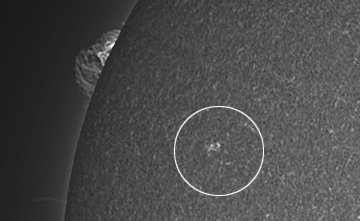
Solar physicists have been waiting for the appearance of a reversed-polarity sunspot to signal the start of the next solar cycle. The wait is over. Yesterday, a magnetically reversed sunspot emerged at solar latitude 30 N, shown in this photo taken by Greg Piepol of Rockville, Maryland:

For reasons explained in a recent Science@NASA story, this marks the beginning of Solar Cycle 24 and the first step toward a new solar maximum. Intense solar activity won't begin right away. Solar cycles usually take a few years to build from solar minimum (where we are now) to Solar Max (expected in 2011 or 2012). It's a slow journey, but we're on our way!
In case you missed it, I posted this quote by Phil Brennan at NewsMax the other day:
2008 will be the year when Al Gore and his forecasts of an approaching inferno will be thoroughly discredited, not by the constantly growing legion of global warming skeptics, but by none other than Mother Nature herself.
Update: more on Solar Cycle 24 at What's Up With That?

Thursday, January 3, 2008

Don't discard your fur coats and winter boots just yet

So says Dr. Oleg Sorokhtin, Merited Scientist of Russia, fellow of the Russian Academy of Natural Sciences and staff researcher of the Oceanology Institute.

MOSCOW. (Oleg Sorokhtin for RIA Novosti) – Stock up on fur coats and felt boots! This is my paradoxical advice to the warm world.

Earth is now at the peak of one of its passing warm spells. It started in the 17th century when there was no industrial influence on the climate to speak of and no such thing as the hothouse effect. The current warming is evidently a natural process and utterly independent of hothouse gases.

The real reasons for climate changes are uneven solar radiation, terrestrial precession (that is, axis gyration), instability of oceanic currents, regular salinity fluctuations of the Arctic Ocean surface waters, etc. There is another, principal reason—solar activity and luminosity. The greater they are the warmer is our climate.

Astrophysics knows two solar activity cycles, of 11 and 200 years. Both are caused by changes in the radius and area of the irradiating solar surface. The latest data, obtained by Habibullah Abdusamatov, head of the Pulkovo Observatory space research laboratory, say that Earth has passed the peak of its warmer period, and a fairly cold spell will set in quite soon, by 2012. Real cold will come when solar activity reaches its minimum, by 2041, and will last for 50-60 years or even longer.
RTWT at RIA Novosti, the Russian News and Information Agency.

h/t: ICECAP

Sunday, April 22, 2007

Neptune warming

via The Reference Frame where we learn...

that Mars, Jupiter, Triton, Pluto, and Earth recently experienced warming. You should add Neptune - another planet that is blue not green - to the list. Moreover, Hammel and Lockwood argue in Geophysical Research Letters vol. 34 that the trends on Neptune and Earth were pretty well correlated, indicating their solar origin.

Monday, March 26, 2007

Quote of the day

He's an actor, a former U.S Senator from Tennessee (Al Gore's home state) and a potential 2008 Presidential candidate. He's Fred Thompson and he filled in on the Paul Harvey radio show the other day.

He's quoted by the National Review Online:

"Some people think that our planet is suffering from a fever. Now scientists are telling us that Mars is experiencing its own planetary warming: Martian warming. It seems scientists have noticed recently that quite a few planets in our solar system seem to be heating up a bit, including Pluto.

"NASA says the Martian South Pole’s “ice cap” has been shrinking for three summers in a row. Maybe Mars got its fever from earth. If so, I guess Jupiter’s caught the same cold, because it’s warming up too, like Pluto.

"This has led some people, not necessarily scientists, to wonder if Mars and Jupiter, non signatories to the Kyoto Treaty, are actually inhabited by alien SUV-driving industrialists who run their air-conditioning at 60 degrees and refuse to recycle.

"Silly, I know, but I wonder what all those planets, dwarf planets and moons in our SOLAR system have in common. Hmmmm. SOLAR system. Hmmmm. Solar? I wonder. Nah, I guess we shouldn’t even be talking about this. The science is absolutely decided. There’s a consensus.

"Ask Galileo."
Here's a link to the audio.

Friday, March 2, 2007

Solar Irradiance is Heating Both Earth and Mars

Kate Ravilious reports for National Geographic News [emphasis added]:

In 2005 data from NASA's Mars Global Surveyor and Odyssey missions revealed that the carbon dioxide "ice caps" near Mars's south pole had been diminishing for three summers in a row.

Habibullo Abdussamatov, head of the St. Petersburg's Pulkovo Astronomical Observatory in Russia, says the Mars data is evidence that the current global warming on Earth is being caused by changes in the sun.

"The long-term increase in solar irradiance is heating both Earth and Mars," he said.

Abdussamatov believes that changes in the sun's heat output can account for almost all the climate changes we see on both planets.

Mars and Earth, for instance, have experienced periodic ice ages throughout their histories.

"Man-made greenhouse warming has made a small contribution to the warming seen on Earth in recent years, but it cannot compete with the increase in solar irradiance," Abdussamatov said.
Ravilious gives the other side their say, you know the "His views are completely at odds with the mainstream scientific opinion" stuff, but then at the end of the article, quotes Abdussamatov who makes a very interesting statement:
"The solar irradiance began to drop in the 1990s, and a minimum will be reached by approximately 2040," Abdussamatov said. "It will cause a steep cooling of the climate on Earth in 15 to 20 years."
Given that observed global temperatures have been cooling since 1998, I wonder how much traction this statement will get from the mainstream media?